Understanding Digital Models, Shadows, and Twins in Manufacturing

The increasing complexity of modern manufacturing demands sophisticated digital representations to optimize operations. While terms like "digital twin" have become common in manufacturing discussions, there are important distinctions between different types of digital representations. Understanding these differences might be quite useful, let's dive in!
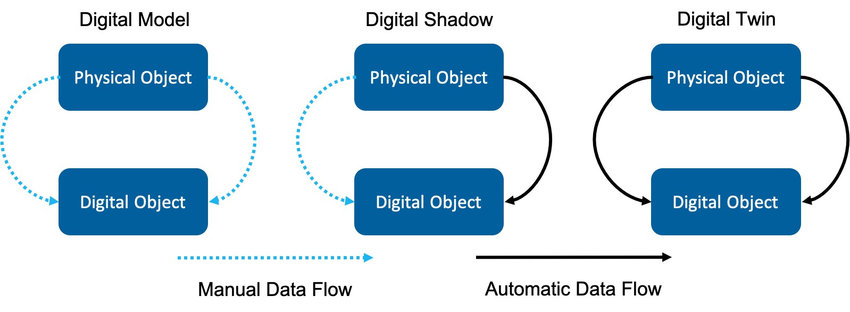 The differences between Digital Models, Shadows, and Twins
TL;DR
- Digital Model: No data flow between the physical and digital world.
- Digital Shadow: One-way data flow from the physical to digital world (i.e., monitor)
- Digital Twin: Two-way data-flow between the physical and digital world (i.e., decision-support)
The Digital Manufacturing Spectrum
Digital representations in manufacturing exist on a spectrum of sophistication and connectivity with their physical counterparts. First up: the connectivity part. Using connectivity to distinquish between Models, Shadows, and Twins is nothing new. Many sources use this distinquish. The figure above shows a graphical representation (adapted from Fuller et al. 2020). Many other authors use similar visualizations. Note that the examples provided below are - not entirely coindicental - taken from the NXTGENHT project.
Digital Models: The Foundation
Digital Models represent the first level of digital representation - a digital version of a physical object or system that can simulate its behavior based on input parameters. While they don't automatically sync with real-world conditions, they provide valuable insights for planning and validation. The Digital Model provides the basis for the classic (and good old) simulation model.
For example, in medical device manufacturing, Digital Models help design and validate cleanroom zones before construction begins. These models ensure that different cleanliness zones (ISO 7 and ISO 5) will work together effectively while meeting regulatory requirements, saving significant time and resources in the planning phase. Note that in terms of scope, this is a rather high-level model. Component-specific (e.g., checking mechanical stress in a motor before production starts) is also a good example of a Digital Model. More on sophisication in a bit.
Digital Shadows: Adding Real-World Data
Digital Shadows advance the concept by establishing a one-way automatic data flow from the physical system to its digital representation. This continuous update of real-world conditions enables monitoring and analysis.
Consider a battery pack manufacturing facility, where component quality depends on precise environmental control. A Digital Shadow monitors conditions during production in real-time, tracking temperature, humidity, and vibrations to ensure optimal quality. While it can't control these conditions directly, it provides vital information for maintaining product quality. The Digital Shadow might for example help an operator to decide when to pauze the production process, change the configuration, and resume the process.
Digital Twins: The Complete Connection
Digital Twins represent the end-game of digital representation, featuring a two-way automatic data flow between physical and digital counterparts. This bidirectional connection enables both monitoring and control, creating a powerful tool for optimization and automation.
One of the most valuable capabilities of Digital Twins is their ability to perform advanced analytics and faster-than-real-time simulations. This becomes essential in two scenarios:
- When systems deviate from expected behavior, Digital Twins can rapidly simulate multiple response scenarios and recommend optimal solutions.
- When predictive analytics indicate potential future deviations, Digital Twins can evaluate preventive measures before issues arise.
In cleanroom manufacturing, a Digital Twin manages complex material routing through airlocks by monitoring pressure differentials and particle counts. Using faster-than-real-time simulation, it can evaluate different routing scenarios when contamination risks emerge, automatically adjusting airflow systems and material transfer timing to maintain cleanliness standards.
Understanding Scale and Scope
Digital representations can be implemented at various level of sophistication, each serving different purposes in the manufacturing ecosystem:
Component Level
At the individual component scale:
- A Digital Model of silicon anode crystallization chambers for precise geometry control
- A Digital Shadow monitoring wear patterns on critical heat pump components
- A Digital Twin controlling medical ventilator flow sensor calibration and validation
Assembly Level
At the machine or assembly scale:
- A Digital Model simulating thermal heat pump refrigerant charging stations
- A Digital Shadow tracking agricultural robot vision system calibration and soil interaction
- A Digital Twin managing automated medical breathing apparatus sterilization systems
System Level
At the facility-wide scale:
- A Digital Model of a silicon anode production facility with contamination control zones
- A Digital Shadow monitoring environmental conditions across battery pack assembly lines
- A Digital Twin orchestrating autonomous agricultural robot fleet operations and maintenance
Implementation Considerations
When selecting a digital representation approach, consider these key factors:
-
Required Detail Level. Match the level of detail to your operational needs and capabilities. More detail isn't always better - bring focus.
-
Data Collection Infrastructure. Ensure you have the necessary sensors and data collection systems to support your chosen digital representation.
-
Integration Requirements. Consider how the digital representation will integrate with existing manufacturing and business systems.
-
Maintenance Resources. Account for the ongoing maintenance and updates needed to keep the digital representation accurate and valuable.
-
Return on Investment. Balance the benefits of more sophisticated digital representations against implementation and maintenance costs.
Looking Forward
As manufacturing technology evolves, the boundaries between these different types of digital representations continue to blur. We're seeing increasing sophistication in physical-digital interactions, while the tools for creating and maintaining these representations become more accessible and powerful.
Getting Started
Whether you're implementing cleanroom controls or optimizing heat pump production, success with digital representations requires a structured approach:
- Define clear objectives aligned with business goals
- Assess current technical capabilities
- Choose appropriate scope and scale
- Implement iteratively, start small
- Plan for future expansion
Digital representations are transforming manufacturing operations, offering new ways to optimize, control, and improve production processes. By understanding the different types and their applications, manufacturers can choose the right approach for their specific needs and capabilities. Regardless of your use case and type of digital representation, the Open Manufacturing Model helps in providing a standardized data model such that the digital and the physical world understand each other.